Showing posts with label reflections. Show all posts

Monday, April 21, 2014

Happy Easter Season!


I am so happy with how these butterflies turned out! They are so light, and glowing, and ethereal! I used a completely different technique from last time. It made me nervous because I wasn't sure it was going to work, and I was working under a deadline! But I feel that although the first batch is more technically correct in their colors or designs, this batch is more true to the airy nature of the butterfly. And, therefore, more representative of Christ's risen body. I left the empty cocoons hanging as a symbol of Christ's empty tomb.


A comment from B made me realize that although we had a tree full of butterflies we shouldn't leave out our daily butterflies, so they all came to flutter around our wreath. And below our butterfly tree there is an abundance of bunnies, birds, root babies and a lamb. And of course the Blessed Sacrament (holy card); the star of the whole season!


He is risen! Happy Easter Season! Alleluia!

Thursday, April 17, 2014

Maundy Thursday


As of last night I did not have any formed plans for marking Maundy Thursday. I had invited some friends over to make unleavened bread, but that was it. As it turned out we had a wonderful time throwing together a shared meal with unleavened bread, hard boiled eggs and charoset. I made up a Seder plate just so we could see the beauty of the display. I don't have a shank bone on hand, and I decided not to put out any horseradish because none of us were going to eat it. Since we were only imaginatively participating in a Passover meal, I thought imaginative shank bones and imaginative bitter herbs would do. It is really lovely when happenings emerge organically. That is definitely something this type A personality needs to learn to trust more often! Perhaps, to further deepen the physical participation in the traditions of the season, me and my little ones will have a foot washing party later on. : )

Tuesday, April 8, 2014

Technical Difficulties and a Change in Operating Proceedure


For some reason it always surprises me when I encounter a project that doesn't sail smoothly from start to finish without any false starts and practice runs. How's that for humility! I think sometimes my vision of the end product is so clear that I cannot fathom how anything could go wrong. If I could only jump right from the planning stage to the finished stage . . . it is all those intermediary steps that trip me up! What? Opaque, heavily painted muslin doesn't resemble the iridescent and multifaceted feather's of a butterfly's wing?! What, do you have to be God  to create a butterfly that doesn't list drunkenly to the side?! What's that about Pride going before a fall . . . ?


I am anxiously anticipating starting my second round of butterflies. This first set was for our "color of the day wreath". In some Waldorf schools they use a color of the day to help preliterate children feel the flow and repeats of the weeks. The colors are pretty standard:

Monday is Purple Day
Tuesday is Red Day (We do pink)
Wednesday is Yellow Day
Thursday is Orange Day
Friday is Green Day (As someone who grew up in the 90's this always makes me laugh!)
Saturday is Blue Day
Sunday is White Day.

I started incorporating the color of the day last summer for just that reason; to help B have a sense of the unit of time we call a week. It was my challenge and goal to organize our activities so that the same thing falls on the same day each week, giving our week a balanced rhythm. The color of the day is to give B a visual way to track where we were in that rhythm. I hung a wreath in the dining room where we can see it prominently. We have had various beings, according to the seasons, help us track the color of the day. These butterflies made their appearance on Ash Wednesday in anticipation of the coming of Spring and the celebration of Easter. A second set of butterflies will hatch out of their cocoons on the nature table Easter morning. That gives me just under two weeks.


Hopefully, with that amount of time, and the practice from the first set I will find a groove, but for some reason I am still anxious. I didn't give myself a whole lot of time before Ash Wednesday to work through the kinks in the technical side of this project. Some of our new visitors didn't take flight until more than a week after their first appearance, and I found myself up late each night painting the next day's butterfly. This is not how I like to work, but I am finding that crafting time is growing scarcer and scarcer.

Because, of course, I am so very rarely alone anymore!


I am facing a shift in thinking. Crafting used to be by and for me. Then, it became for me and my children, but still by me. Slowly (or not so slowly!) it is becoming crafting by me and my children. I honestly don't know how I feel about that! (blush) Ultimately, I hope very much that my children learn from me, and enjoy making things with their hands. I hope to pass on the confidence of being able to tackle any project, and the enjoyment of making beautiful things.  But there is a part of me that really enjoys creating something and setting it out, unexplained, to be found, and played with, and marveled at. And there is certainly a part of my that enjoys working in peace without having to stop mid flow to fix, or straighten, or clean up. I suppose it will just take some adjustments in time management; definitely some patience on my part; and some clear boundaries about which is my project and which is our project.


Sunday, April 6, 2014

Passiontide

Passion Sunday brings us to the last two week stretch of the season of Lent.


Our caterpillars have closed themselves into their cocoons.


Our little felt bulb babies have been covered over with a warm layer of wool.


(After some sorting) the Christmas Limas have been planted.


Our Easter wheat has been sewn into the soil.


Our icons have been veiled.


Along the road to Easter we have come to the point where we begin to dwell on the enclosure of the tomb. "Truly, truly, I say to you, unless a grain of wheat falls into the earth and dies, it remains alone; but if it dies, it bears much fruit" - John 12:24. We have surrounded ourselves with seeds of hidden transformation. Although everywhere we look we see only the outer, lifeless surface, we heard today the story of one man's unexpected emergence, and the cry that has been taken up in our house is "Lazarus! Come Out!" In the coming weeks, through our symbols, we will begin to see how life emerges out of the tomb.

Tuesday, April 1, 2014

It's Still Lent!


Now that we have had two whole days of spring like weather, I am noticing how different it is to try to maintain an inward, contemplative, Lenten mindset. While it was snowing and sleeting outside it just made sense to be eating beans and forgoing treats. Now, it takes some work to remind myself of the season. I am actually finding it to be a lovely bit of work, though. And there seems to be that little spark of hope and lightness in everything that means Easter is coming.

We've been listening to this on repeat: (Kind of a weird video, but I love this rendition of the song.)


I have always loved American revival (style) music, but I haven't known where it fits in to our Catholic life, until this Lent. Somehow it clicked for me that the same spirit of letting down one's guard, and letting God in runs through both the music of the American revival movement, and through the ancient tradition of Lent. In both there is a call to reach into those places where we find our limitations, and to respond by shoring up the limitations of others and by reconnecting to God's vision for us. So, as a way to maintain our Lenten spirit in these beautiful, burgeoning, budding days, I have been relearning the lyrics to some of my favorite songs. (I will readily admit that I don't really know if these are actual American revival songs, but, to me, they have that old timey feel, and they have that lenten attitude. :)


Friday, March 14, 2014

Tips for Starting a Seasonal Table


A friend of mind recently asked me if I had any tips for starting a seasonal table. I thought I would share some examples of simple seasonal tables and give some idea of where I started. I hope these ideas will be helpful! [So, this got kind of long! If you are just interested in some tips you can skip down to the ***** section! : p)

I greatly admire the seasonal table tradition that comes out of the Waldorf school movement. Because the Waldorf early childhood curriculum is based entirely on the seasons, early childhood classrooms have "nature tables" to help reflect the outside seasons indoors. There are a few things that Waldorf nature tables have in common, in my experience.
  • First, they are spaces that are set apart. They have a designated shelf, or table top, or bureau where the nature table always is. It doesn't move around the room, or get placed higglety pigglety, or thrown to the side when that shelf is needed. In this way, the nature table is a little bit alter like. It's not an alter, no one worships there, but there is something reverent about its placement.
  •  Second, while it varies from classroom to classroom whether children are allowed to play with and touch the nature table, there are almost always rules that the objects on the table must stay there. So, even if a child is allowed to move things around and play there, the play must stay at the table. In many cases though, the nature table is just there to be "admired" and is not for play. 
  • Third, the decorations and objects found on the nature table are almost always made of natural material; silk, stone, wood, seed pods, wool, shells, cotton, flowers, etc.
  • Forth, there is usually some representation or personification of the season; a figure like "King Winter" in winter, "Prince Autumn" in the autumn, or the Holy Family during Advent and Christmas. 

While I have never seen any rules for how to put together a nature table, these four aspects have been present in pretty much every Waldorf nature table I have seen.

In a Waldorf school the idea is to bring, into the classroom, the mood of the season. Colored silks are used to create a landscape which mirrors the current season. Figures are there to personify the season, and objects from nature are used to enhance the effect. Seed pods or flowers remind us of what is going on in the gardens and fields. Branches become trees that house little felt birds or piles of silk snow.  King Winter spreads his white cloak over the ground, or Mother Earth's blanket covers the table with fallen leaves. There is sometimes space for children to lay the "treasures" they find on a walk, but the underlying display is a scene designed by the teacher. There is a certain amount of whimsy that comes in here because objects are used not only to represent accurately what we are seeing in nature, but also as props for the figures. Therefore, a large sea shell becomes a pond for little fish, or hollow logs become homes for gnomes. Again, all of this is meant to bring the mood of the season into the classroom. Its purpose is to hang as a background to the children's play, and only rarely does it get mentioned or actively sought out.

Waldorf schools are not the only ones who have nature tables, however. A quick look through Pinterest reveals that there is another style of nature table. Sometimes found in Montessori classrooms, or in home school rooms, these "natural history style" nature tables have the more concrete purpose of giving children a direct and focused exploration of nature as the foundation for science. (Examples can be found here, and here.) The natural history style nature table has the first three aspects from above, a designated space, rules about how it is to be used, and natural objects. There can be trays that help categorize the objects; feathers, shells, seeds, grasses, etc. There are sometimes books and field guides. There are sometimes microscopes and magnifying glasses. All of these facilitate the child's understanding of the objects of nature. All the objects and tools, neatly laid out on the natural history style nature table, are quite beautiful, and quite different than the Waldorf nature table.

I personally like the whimsical character of the Waldorf nature table, and the look of draping silks, so our table often looks very "Waldorfy". I also really like the role the figures play. I like personifying the forces of nature. (Perhaps it is the artist in me?) I like representing the spiritual realities of angels alongside the natural world. I like that a season (be it a week, a month, a yearly quarter) can take on the character of a person. For example St. Michael the Archangel, for me, characterizes the whole Autumn season, and so he is present on our nature table right alongside the apples, and squashes and fallen leaves. And right now, with small children, I think that the relationship between the human, the divine, and the natural is more important to display than the concrete, scientific name of those same fallen leaves. I hope that as my children get older we can incorporate more found objects into our nature tables. As it is right now, however, with a three year old who is only beginning to understand how to put things away, and a one year old who puts everything into her mouth, I have to carefully select and limit the number of natural found objects we bring into the house.

*****
All that theory aside,
  • I would start with a designated space.
  • I would decide if I want the children touching it, not touching, playing gently or what have you. 
  • I would get some cloths for the background/table cloth. Years ago I started with cotton cloths. I bought them in different seasonal colors. Some even had patterns to be leaves on the ground, running water etc. At the time I found silks to be hard to get and/or expensive. Now I get my silks from Dharma Trading Company. I dye them myself using fruits, vegetables and natural dyes. Lil Fish Studios is a blog that talks a lot about experimenting with dyes; it's a good blog to browse. Here is a beautiful post from Poppytalk about experimenting with food as dyes. Here is an article from Mother Earth News about mordanting your fiber (yarn or cloth) before dyeing it. (Mordanting helps make the color brighter and fade less over time.) If you are interested in a quick dye job, but don't want to spend tons of money or learn the whole art of dyeing, you can use Kool-Aid. I don't have any experience with this though, and I would guess that the colors end up being more neon and less natural unless you use several colors at once so they mute each other.
  • You can use things under your table cloth to add contours to your landscape. Small food boxes (well cleaned, of course!), rocks, small stumps (like those cut from the end of the Christmas tree), etc.
  • Now that the table is set it's time to set the scene! You can start bringing in items from outside, a small vase of flowers, small branches, interesting knots of wood, stones, crystals, leaves, bark, shells, etc.
  • And then come the figures, which require a whole post to themselves! Although, I will say that the quickest people are peg people, especially if you choose to paint them rather than dress them in cloth. You can find my tutorial for making peg dolls here.
  • And then, just realize that this is going to be a process. One silk, one figure, one pine cone at a time you will learn your own style, and you will learn which elements are important to you. Enjoy the journey!
  •  
*****
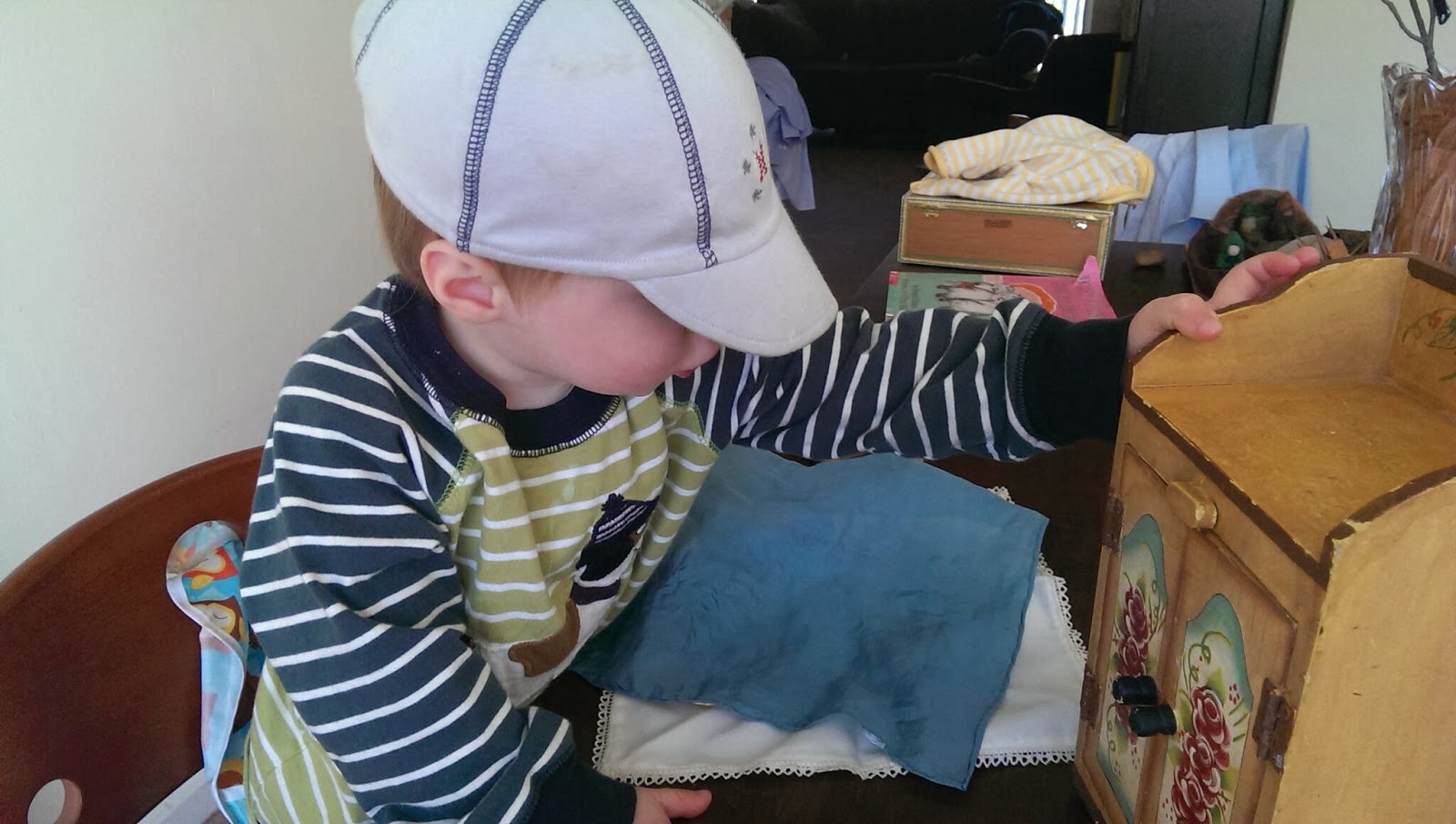
Here are two examples of very simple nature tables. The first is B's seasonal table. We found this sweet little chest at the thrift store. It sits in B's room, and is totally accessible to him. It often gets used for other purposes (as you will see!).


I made a little gnome to live in the lower portion with his crystal. I liked that the chest gave us the opportunity to have many layers of beings. Since gnomes are associated with the underground, I put him down below.


The saints peg people sit on top. The table cloth is a little folded silk handkerchief. In theory we could change the color to reflect the season, but we haven't really done that. The icon is always there.


B really prefers to use the chest as a tabernacle : ) I recently put the gnome away because B usually takes him out anyway, and he's right; the chalice and paten look right at home in there!


This next one was created by my friend and colleague Liz Hagerman for the parent and child classroom at Acorn Hill Waldorf Kindergarten and Nursery. So simple and so beautiful! (Note; this nature shelf hangs above the reach of the little children who use this classroom. So, not for playing with, but for admiring.)


A little shelf. The background hangs from the wall. A small vase and candle. Three felt stars.


And two wee babies! Perfect!


Wednesday, February 19, 2014

On Nursing

"Was this to be the last kiss she ever received from a little mouth, sweet with milk?" 
 Kristin Lavransdatter by Sigrid Undsent Book II, Part III, Chapter IV. 


 I had an epiphany last night which completely changed the way I view how I have fed my babies. You see, M and I have only recently stopped nursing. She was almost exactly ten months old and it was bitter sweet, but we were both really ready. I had always dreamed of nursing my children for years. My youngest brother, the only one whose nursing relationship I remember, nursed until he was four years old. I grew up perceiving that nursing was a wonderful thing that every mother was able to do. I loved the natural, earthy, consonance of breastfeeding, and I longed for the days when I would nurse my own children. So I was completely brought to my knees and devastated when I was unable to produce enough milk to exclusively nurse B. But there had been a thousand complications with my pregnancy and his delivery, and so, when I was able to raise my head and look forward again I told myself, "next time".

 Yes. Next time. Well, at three weeks old M was not gaining weight. And slowly, half an ounce at a time, she took more and more formula. I struggled with justifying my desire to nurse her with actually providing her with food. I wracked my brain trying to figure out where I had gone wrong. I wept every time I offered my daughter a bottle. And then I would feel guilty about wanting to control how much she got from a bottle so her demand would still up my supply. We ended up precariously balancing bottle feeding and nursing with a lact-aid nursing supplementer. But she was taking a full 24-30 ounces of formula per day, and when she was really hungry, she wanted a bottle. And, while using a supplementer allowed me to nurse M, it was cumbersome and finiky and just not natural. I am happy that we struck a balance that worked for as long as it did, but I did roll my eyes at myself for using bottles. Not because no one should use bottles, but because I felt like I was cheating on my own ideals.


I have a friend whose experience is eerily similar to my own. Her pediatrician comfortingly pointed out that, had it been six hundred years ago, there would have been other women around who could take our children and feed them. (The way God and nature intended, I bitterly added to myself). She assured my friend that we do things differently now, in this country, but that doesn't mean we don't care about our babies. But still I rolled my eyes at bottles and formula. They aren't dynamic. They aren't human.

 And then I read Kristin Lavransdatter, by Sigrid Undset. It is not a book about breast feeding. But it is a book about 14th century Norway. And in 14th century Norway, when babies, for whatever reason, are not fed by their mothers, they are fed by foster mothers and wet nurses. And, although it had never occurred to me, those babies develop close, natural, earthy, consonant relationships with their foster mothers. And they might even fuss and reach out for their foster mothers when held by their own mothers. And that would have broken my heart more than any bottle. 

I sat in bed last night holding my baby girl as she held her bottle, and I was so, so, so grateful that I am the one who feeds her. She likes food more than her bottle anyway. She is learning to drink from a cup. The bottles will be put away eventually. But I am the one she turns to when she needs something.


Tuesday, January 28, 2014

Doing

Over the course of this month I have seen several bloggers picking out a word by which to guide their lives for the coming year. I had never heard of this practice, but some folks were retiring last year's word which means that it's a tradition that is at least a year old (and probably longer). :p
I didn't sit down right then and there to figure out what my word would be, or even if I would have a word. But in the past few days I have felt a grasping at something, a need to identify an underlying course. And it clicked, just now, with the word "doing".
I am very good at dreaming. And with a little baby and a toddler it is difficult to really get involved in anything for any meaningful length of time, or make any progress, or get anything done that isn't immediately undone. And so I have been dreaming. Daydreaming. Novel dreaming. Planning dreaming. Pinterest dreaming. Even very necessary restructuring-my-own-ideals dreaming.
But all of that is invisible to little children. And it is worse than meaningless because it takes me away from them and into my own head. And when I see B being a gardener, or a worker or a "cooker" I see what does have meaning for them: "doing".
So, my word for this year is "doing". Not necessarily "accomplishing". Or "finishing". But "doing".