Tuesday, May 22, 2012

Day 2 of the Flats and Handwash Challenge


___________________________________________________

O mothers let's go down,
Come on down, don't you wanna go down?
 Come on mothers, let's go down,
Down in the river to pray.
___________________________________________________

It might be funny, but when I was imagining hand washing these diapers I couldn't help but think of all the women throughout the ages who have gone down to the river to wash their family's clothes, and this song popped into my mind. I think it is perfect, actually, even though it isn't about laundry. I am reminded of St Therese's ideas of finding holiness in the little things of life, like sweeping or washing clothes.

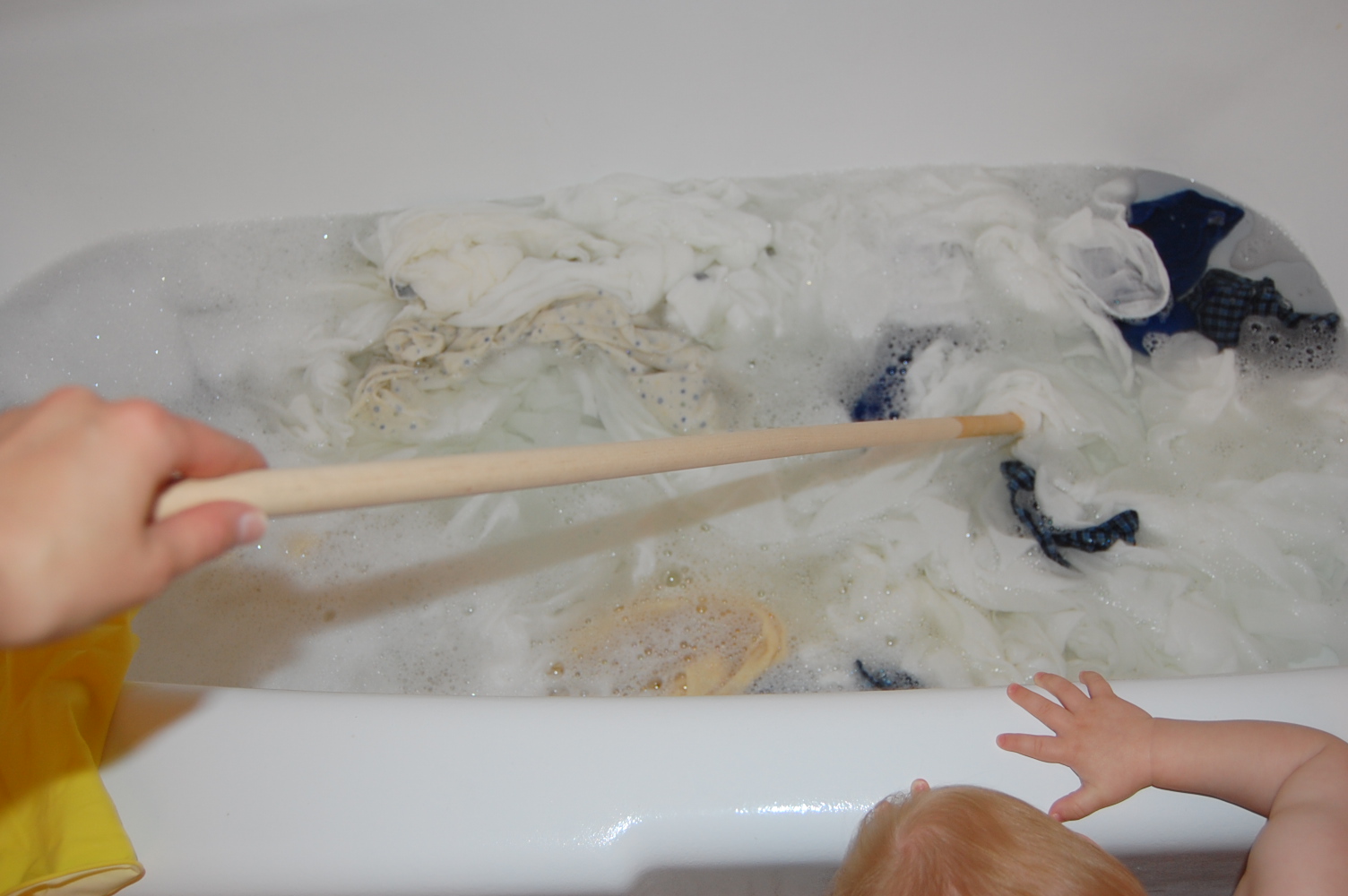
Well, I didn't exactly feel holy while washing diapers this morning, but I didn't feel as wretched as I expected! I decided to use our bath tub as the wash station. I like the idea of using a camp washer, like many are doing, but I didn't want to invest in the parts, and then have to store them when the challenge was finished. So here is my mixture of "Target flats", Hemp Babies flats, flannel blankets, surgery drapes, and cloth wipes (which I made from an old skirt). They are in the bath tub with their soapy suds. My latex gloves are to the left.
 

My normal washing machine routine, with which I am very happy, goes like this:

                          Hot rinse
                          Hot wash with soap/ cold rinse
                          Warm wash with soap and covers/ cold rinse
                          Cold rinse

And I normally use a dry pail for dirty diaper storage. Now, for the challenge, I am washing my covers separately, and like I mentioned yesterday, I have changed my dirty diaper storage to a wet pail, so that is my first rinse.

So today, my routine looked like this:
                          Cold rinse (from the pail)
                          Hot rinse and hand agitation as I unfold the flats
                          Hot wash with soap, soak and agitation
                          Hot rinse with agitation
                          Warm rinse and inspection

I was surprised at how very easy this was! And the flats got really clean! I used a long dowel to agitate, I used my gloves for whenever I had to touch the dirty diapers, and in the last rinse I inspected each one to see that it was clean. So my supplies for washing were very simple: bath tub, gloves, dowel. I think it took me no longer than and hour and a half, and it was by no means all active time.

I had a "helper" too.

And this fellow narrowly escaped being dumped in with the first dirty load.

When everything was clean, I wrung them each out by hand.

My diaper sticks.

And hung them outside,


and in.


I have been searching for a drying rack for months now, and the problem isn't that I can't find any, it's that they are too durn expensive. I do not want to spend $25 on a simple wooden rack. I was amazed and pleased to see this idea from Mamawords and I was even happier that I actually had a section from our baby gate laying around. The drying rack you see above is the section of baby gate leaning against the wall. Hooray!


 Below is a Hemp Babies insert. I guess it's not technically a flat diaper, but it certainly works like one!


Monday, May 21, 2012

Day 1 of the Flats and Handwash Challenge

I am taking part in the Second Annual Flats and Handwashing Challenge hosted by Dirty Diaper Laundry.  For 7 days I will be using only flat cloth diapers and handwashing them in an effort to prove that cloth diapering can be affordable and accessible to all.  You can learn more about the rules and why this challenge was started by visiting the announcement post.  This year there are over 450 participants from all over the world! 

 This is a flannel receiving blanket used as a flat diaper.

As I mentioned before, I am participating in the challenge in order to see for myself how feasible it is to hand wash diapers. I would love to support anyone who wants to use cloth diapers, and I want to know whether cloth diapers could be the answer, no matter one's circumstances.

I feel nervous about a few things going into this challenge. First, I was nervous about making flat diapers last us through the night. In the rules for the challenge everyone is allowed one "night time diaper", that is a heavy duty diaper of your choice, that you know will last your child through the night. But, being a bit stubborn, and wanting to make this experience more "realistic" (more as though I truly couldn't afford any fancy diapers), I was determined to make flats work. Well, as it turns out, for practical reasons I have been using flats at night this past week. And they have worked beautifully! So, that is one challenge overcome!

Another thing that is making me nervous is wondering whether I have enough flats to get me through to wash day. I am hoping to wash every other day. I don't usually use flats so I didn't want to make a big investment. I did have a few on hand just to try them out and to use for extra absorbency, and I did buy a few more inexpensive ones, but I don't think I have a full stash of flats.  I will need diapers for one night, one day, another night and wash day.  Hmm, writing it out like that, I am not sure I do have enough. I have 28 flats in all; 19 "Target flats" (flour sack dish towels), 2 hemp and cotton Hemp Babies xl diaper inserts, 1 flannel receiving blanket (see photo above), and 6 surgery drapes (I will include pictures of all of these throughout the week). That sounds like a lot, but I use two flats for each change and three for each diaper at night (usually 2 per night). I did notice that in the DDL tips section it mentions washing after each change so that the laundry doesn't build up. Maybe I will incorporate that into my routine, and then do one big wash every other day. We'll see how it goes!

The other thing that makes me nervous is not getting the diapers clean enough. I usually think of handwashing for those fancy clothes that never really get dirty. I do have a wash board, and I did change up my dirty diaper storage system a bit in ways I think will help. Again, we will have to see how it goes!

Another eventuality that has come up: since we have had beautiful whether these past months, I was fully intending to dry my flats outside on a makeshift line. But of course, we woke up this morning to a drizzly humid rain. And it doesn't promise to be any better all week.

So these are all the things that I am nervous, but excited, to be facing this week.


Sunday, May 20, 2012

Wednesday, May 16, 2012

Winter Wrap Up

Last fall I decided that in order to make sure B would be as warm as possible, and wear as many natural fibers as possible, I was going to have to make his winter wardrobe. Wool clothing is very expensive to buy. We were going north for the holidays, and I wanted to make sure he had all the layers he needed. 

I still felt funny about giving B a blanket at night, so I knitted up this adorable sleep sack. 
The pattern is The Kicky Pickle Sleep Sack by Silly Daisy Designs on Etsy.

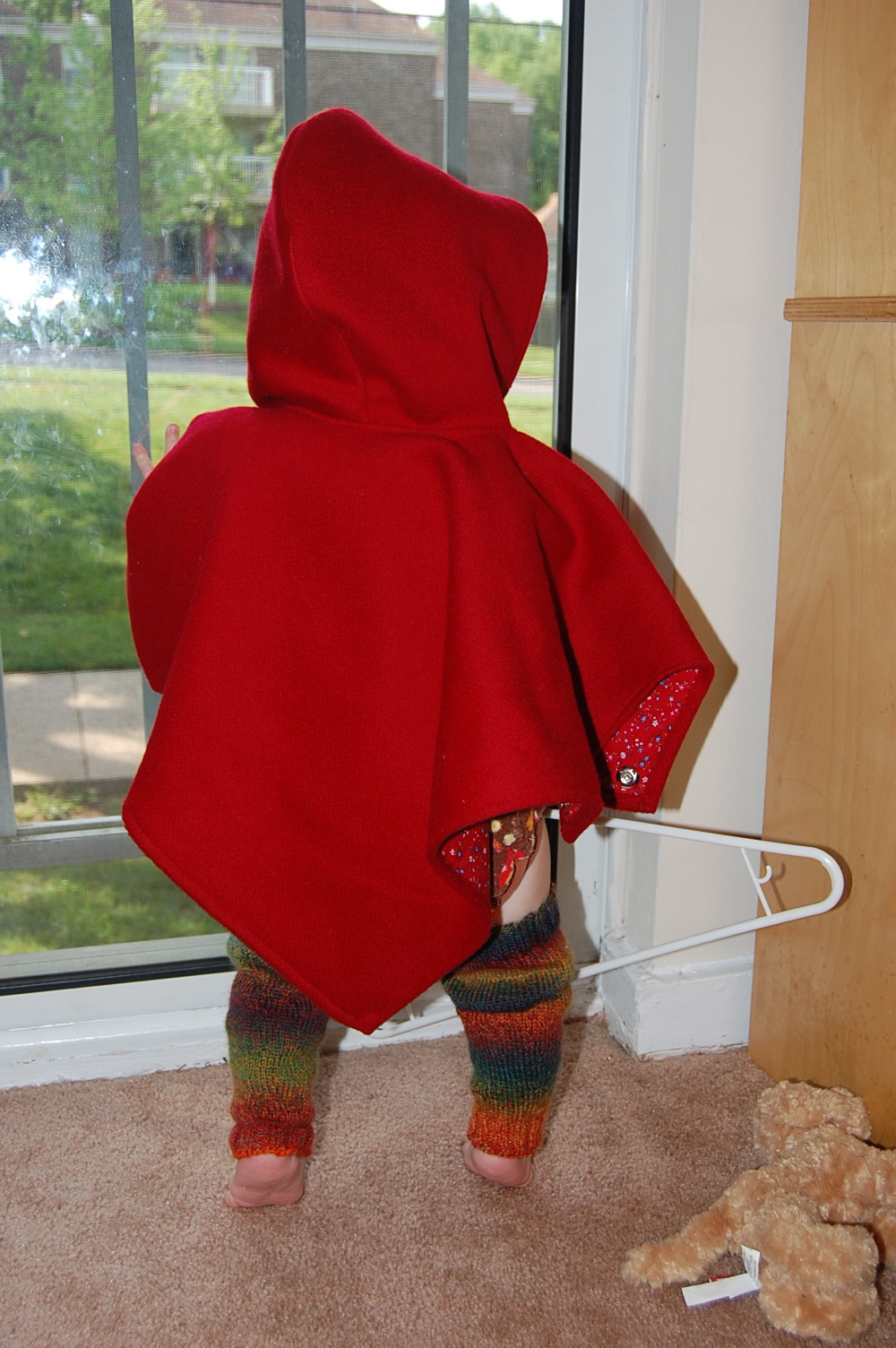
I used up the rest of the yarn making this hat and vest of my own design. The diaper is a fitted diaper made with the Trimsies pattern. The leggers were a pattern of my own, or rather, I made it up as I went along. It took me a while to get them right though, and I actually finished them after Easter. Luckily he hadn't needed them! The red cloak he is holding is the third in a series of coats I made for him. I had the fabric lying around. My dad had given it to me, because I had been wanting to make myself a revolutionary war soldier's coat (I am continually amazed at how the things that I have secreted away for precious projects for myself are willingly turned into things for B!). I knew my dad had said the fabric came from somewhere special, but I had to call him to jog my memory. Apparently, it is actually from the movie "The Village" from 2004.


The first coat, while adorable, was not going to fit him for long. This is B at 10 months in the 12 month sized coat.


As it turns out, there was an error in the sizing of the pattern, so I went ahead and made the largest size coat. I modified it so that it would grow with B. You can see the sleeves are pretty long, so I used a cute pattern on the inside so it would show up when I rolled the sleeves.


This is the sleeve inside out so you can see that the top of the sleeve is made of a shiny fabric. This is to help little arms slide right in.


This is the bottom hem of the coat skirt, from the inside, and I have lifted up the lining so that you can see that there is a double row of stitching on each seam. The entire underarm seam is double seamed. Hopefully, when B grows I can just rip out both underarm seams and he will have about an inch of extra room.


As it turns out, it is actually not advisable to dress babies in bulky coats when they are in their car seats because the bulk of the coats interferes with how tight the straps can be. So I made the cloak/poncho because the car seat straps can go under it, but B is still kept warm.

So, these are all the projects that I was working on last fall and into the winter.
 That is my Winter Wrap Up!

Coming up next week: The Flats and Handwash Challenge!


Saturday, May 5, 2012

Meal Time

A friend just asked me today what system I have in place for managing meal planning and execution, and if I had any tips for eating in a healthy, balanced way. I would have never thought to call what I do a system, but her question reminded me that I actually have heard of several systems for simplifying meal prep. I thought I would write down all the ones I have heard of, to keep track of them, and then, when I hear of more, I could add them and maybe it could be helpful to someone. 

My background is in the Waldorf schools and they have a very steady food rhythm which I think is helpful because it narrows down the choices each day so that they are not overwhelming. In our kindergarten we had the following snack schedule:

Monday--Rice Day
Tuesday-- Bread Day
Wednesday--Soup Day
Thursday--
Friday--Oatmeal Day

(Thursday was actually difficult. We started with Steamed Golden Millet with soy sauce, but few children would eat it. Then we switched to millet with maple syrup, but still few would eat it. When I left, we were having carrots and celery with humus, and millet muffins with butter. Still not a big hit.)

For children having a simple repetitive schedule is beneficial because they know what is coming each day and it gives their lives some predictability. For grown ups this is beneficial because it allows us to fall into a peaceful rhythm of activity, and we don't have to be a super creative master chef each day. It also happens that when children are faced with the same foods week after week they will (except for millet apparently) learn to like foods they otherwise would not have even tried.

I was present at a talk given by Sharifa Oppenheimer, the auther of the book Our Heaven on Earth, and she proposed a similar idea. (Oppenheimer is also quite familiar with Waldorf schools.) She had created a rhythm for dinners of the week, but instead of having specifics like "rice", "bread" and "oatmeal", she had broader categories, more like "soup". I don't remember all the specifics, but she had things like "roast" on Monday (could be veggies or meat), and "pasta" on Tuesday. I think this narrows down the options in a simple way that still allows for creativity. One could even coordinate the easy type meals with busier days.

I was present at another talk given by Monica Corrado of Simply Being Well, and she had her own spin on a balanced meal. Corrado is deeply influenced by the Weston A. Price Foundation and their take on nutrition, so she advocates that a balanced plate would have one half cooked food, one quarter raw food and one quarter fermented foods. Whenever I mention this, my husband says, "fermented! I love beer!" But that's not quite what Corrado is going for. For more information on the use of fermented foods you can check out Corrado's website, the Weston A. Price Foundation, or the cookbook Nourishing Traditions by Sally Fallon.

Corrado also developed a beautiful chart that outlines how to feed a baby in a wholesome way following the guidelines from the above websites. It is divided by month and slowly introduces wholesome foods that are packed with nutrition. I have been drooling over the chart since I saw it in person at our Parent/Infant class. Here's where you can get a glimpse. (You have to click the "see sample chart" button.)

And then, of course, there is the government food plate.

So for the government meal plate I guess one would just take it into consideration when making a dinner shopping list: 7 grains, 7 veggies, 7 proteins, 7 fruits per week. If you wanted to combine that with Corrado's divisions, you would just prepare one half of each nights options cooked, one quarter raw and one quarter fermented.  About a year ago I was really interested in the overlap between Corrado's work and the food plate, and I came up with a chart that combines them.

The center circle is the food plate. From left to right, clockwise, it reads, Proteins, Vegetables, Fruits, Grains. The blue circle off to the top right is for Dairy.


The outer circle reads (again from left to right, clockwise) Cooked, Fermented, Raw. The outer circle swivels around the inner circle, and, as it does so, it reveals through the little windows recipes for preparing the particular type of food in a particular way. For example, in the picture it is showing how to prepare cooked grains and proteins, fermented vegetables, and raw fruit. The dairy circle has its own little wheel to reveal recipes for cooked, raw and fermented milk, cheese, butter, yogurt and cream. The recipes can be found in the Nourishing Traditions cookbook. Ideally, the recipes on the chart would be coordinated so that each combination of recipes that was revealed would be a complete meal. But I didn't get that far.

There have been a number of posts on the blog Bread With Honey about how to use bento boxes to layout a meal in such a way that you can see the balance between food groups. There are some good ideas about what to do for lunch too.

I love all of these ideas! Maybe I can somehow incorporate all these systems to create one master system! Maybe I should just add a brain and some arms too, and let it make dinner for us!

But until I can figure out how to do that,  I have found that a simple list of must haves for each meal has been helpful for me. For breakfast I must prepare:

1 piece of fruit
1 piece of bread
1 egg
1 glass of milk
1 glass of orange juice
1 bowl of yogurt or cottage cheese
1 bowl of oatmeal (or another piece of bread)

With this list in hand, I find that I prepare all the food at once, rather than getting a bowl of cereal and staving off the hunger until the next catch as catch can "meal". Whatever doesn't get eaten becomes my snack before lunch. I can be creative with this as well. I can replace the bread and milk with a bowl of cereal, the orange juice with another piece of fruit. I can add the fruit to my oatmeal, or I can make a breakfast burrito with egg and cheese, and that counts as my egg, my bread and my yogurt.
For lunch the list looks like this:

2 pieces of bread
Filler (like egg salad or tuna) or mixture on the side
2 pieces of fruit
1 cup veggies
1 cup milk

Dinner is 1 protein, 1 grain, one veggie. These lists are based entirely on what satisfies me and my family at the moment. And I am sure that it will change. My husband also has started to develop a list of foods/meals/snacks we know we like, so when I feel stumped when writing the grocery list, I can refer to that.

After writing all this down it seems like there are a few things in common with all these ideas. First is that narrowing one's options allows one to be creative, but not overwhelmed. So whether one narrows the option to one food, one list of foods, or one type of preparation, the creative constraint allows for less frustrating planning. 

The second thing that pops out at me is rhythm. If one always grocery shops at the same time each week, one becomes accustomed to writing the list at the same time each week. If one prepares dinner at the same time each day, it gets easier and easier to just slip into that activity. If one prepares the same kind of foods each day or each week, one begins to anticipate "Rice Day" or "Spaghetti Day".

Third is, "how does it look?"  If one prepares food in a beautiful way, it becomes easier to notice if it seems unbalanced. Whatever balance theory you subscribe to, it seems easier to achieve it when you can look at the proportions before you.

As far as nutrition goes it is always helpful to choose nutritionally dense food. Foods that have brilliant colors, or foods that were meant to nourish their own next generation (eggs, nuts, milk, seeds, fruits) are designed to build up strong bodies. And they will build up ours too.

Dinner (and all meals) can be so frustrating! I really am trying to make it easier and more enjoyable for myself. It seems like there are a lot of tools to be had from all these ideas!

Thursday, May 3, 2012

Flats and Handwash Challenge!

Before I explain the title I want to state that we use cloth diapers for B and we plan on doing so for any future children. My husband's favorite reason for cloth diapering is that it saves us money. It's a one time, upfront cost, and we never have to buy diapers again. My favorite reason is because it saves landfill space. Other reasons families cloth diaper are to avoid rashes caused by the chemicals in disposable diapers, and because cloth diapers can be very cute.

Now, having just revealed that I don't have enough time/energy in the week for all the stuff I have already chosen to do, I am still going to announce that I will be participating in the Flats and Handwash Challenge hosted by Dirty Diaper Laundry! This challenge runs from May 21 to May 27. One week. Using only flat diapers. Handwashing them the whole time.

 Yuck? Maybe.
But better than reusing disposables!

This is the second annual Flats and Handwash Challenge. Last year the event was inspired by numerous articles which brought to light the fact that families who had to choose between diapers and food, were desperately trying to extend the life of their disposable diapers. In some cases families were allowing their children to sit in dirty diapers for many hours at a time (4 . . . 5 . . . 6 . . . or longer). And in other cases families were attempting to clean out or blow dry their disposables to be reused a second time. None of this is good for children! And, currently, there are no government programs to help families who need diapers.

Are cloth diapers the natural solution? I have often asked myself if I would continue to cloth diaper if I had to go to a laundry mat to clean them. My stubbornly idealistic self says "yes!", but in reality I am not so sure. We made a special effort to find an apartment with a washer and dryer, but this isn't always an option. In addition, Kim Rosas of Dirty Diaper Laundry points out in her 2011 Flats challenge post, that the start up cost of cloth diapering is mostly likely way too high for families who are already struggling.

 For both of these reasons, flats and handwashing may be the answer. Flat diapers are the original cloth diaper. They are relatively inexpensive; $1-$7 each, whereas more elaborate diaper systems are in the $10-$25 each range. Flats consist of one layer of cotton fabric. They are large rectangles which can be folded to fit any child. This means they will fit one child from birth to potty training, or two different sized siblings at the same time. Their thinness means they can easily be washed by hand and are quick to dry. Hand washing at home means it can be done at anytime, and there is no trip to the laundry mat. But are these the answer? We will have to see how well we survive the challenge!

For myself, I want to attempt this challenge because I want to see if it makes sense to advocate cloth diapering no matter one's circumstances.

For more information please visit www.dirtydiaperlaundry.com

Our Day


In an effort to put a little order to our day, and to try to fit in all the chores that seems to accumulate so quickly I made ourselves a chore chart. Well, no, it's not only a chore chart, it is our Daily Rhythm chart. The body of the chart is what we do everyday. There is also a pocket on the lower right hand side that has seven cards, one for each day of the week, with our weekly chores distributed among them. In case you can't see it very well (sorry!), the list looks long, but it includes things like prayers, eating, time for chores and outdoor time.


I have been struggling a bit with getting everything done each day. And with getting everything done each week. Monday starts out strong, but by Wednesday morning . . . not so much. I thought I would try to show you just how far I am from actually following these goals, but the day I tried to keep track, I actually did really well! Aside from having to wait for the UPS man in the afternoon, and not grocery shopping (luckily my husband had done it that weekend) I was right on track!

But what I found was that the little things not on the chart, the things I get frustrated at because I feel like they are distracting me from my schedule, are the funniest and nicest parts of the day. At least in retrospect. So on the day that went perfectly, where I actually managed to stay on track, I also managed to wash a pair of B's wool paints that should NOT have been in the washer (luckily they didn't shrink too much!), make breakfast while B poured crackers on the floor (I guess I wasn't quick enough!), and caught him licking the plate glass door (um, yum?).


What I really need to remember is that the chart represents our daily rhythm, not a schedule.

***

 B really enjoys his "chore".